A theology that begins with a pond — and asks what the watershed has been teaching us about God, prayer, and what it means to belong to creation rather than manage it.
Enter ↓Seven Anchors
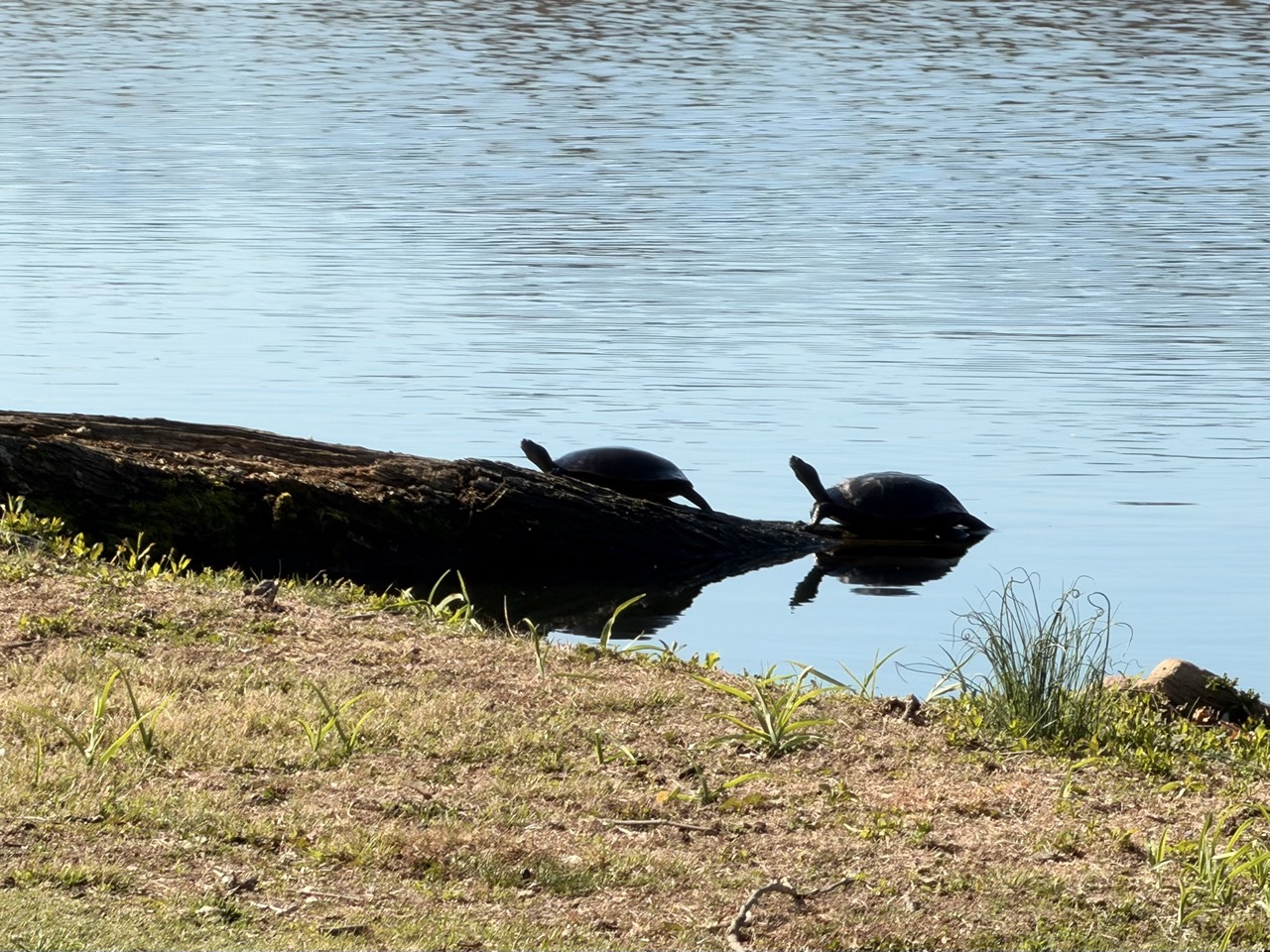
St. John's Pond sits at the head of a watershed in Cold Spring Harbor, New York, on the grounds of an Episcopal parish that has owned it since 1831. For nearly a decade, the question driving BlueGreen Theology has not been "what does the pond illustrate?" but "what is the pond teaching?" That is a different kind of inquiry. The first looks at the pond and sees evidence for something already known. The second stands at the water's edge and waits to be instructed. BGT did not begin with a doctrine and find a pond to demonstrate it. It began with a specific place — fourteen acres, cold springs, a wooden weir, red-winged blackbirds in the cattails — and let the theology follow from what was actually there. The pond is not an illustration. It is where the argument lives.
Stewardship has been the dominant frame for Christian environmental engagement for decades, and it is not a wrong frame — but it is an incomplete one. Stewardship positions the human being as the responsible agent: the manager of an estate that belongs to someone else, acting from obligation, maintaining supervision. BlueGreen Theology proposes something different: creaturely solidarity, organized around the recognition that the forests and the whale communities and the migratory birds are members of the same assembly we inhabit. They have their own standing before God, their own forms of praise, their own stake in the life of creation. We do not tend them because we are obligated to. We tend them because we belong to them, and they to us — the way you show up for a friend in a crisis, not because duty demands it, but because that is what belonging looks like. Stewardship is compassion with a fence around it. What BGT proposes is kinship without the fence.
The Psalmist does not invite creation to praise God. The Psalmist commands it — on the assumption that creation is already capable and already doing so. The river flows, the tree grows, the mountain stands: each manifests divine generosity through its very existence, without self-reflective distance, without the gap between intention and act that human consciousness creates. This is not lesser participation in God's life. It is immediate, unmediated relationship — what the tradition might call primary speech, communication that arises before self-conscious construction. Human prayer does not initiate worship. It joins what was already happening. We arrive late to a service that has been underway since before the first light, and what we bring is not our superior capacity for reflection but our willingness to add our conscious voice to praise that has never needed us to be real.
The first fence to come down was a physical one — between the church's manicured property and the wild woods behind it. It wasn't keeping anyone out; people were already climbing over it, and the most obvious path to the walking trail beyond was simply blocked by something that had stopped doing its job. When the chance came to remove it, the decision was easy. But that fence turned out to be several fences at once: the fence between the sacred and the natural, between the parish and the watershed it inhabits, between conscious human prayer and the unselfconscious praise creation has always been offering. Richard Rohr observes that we are not, and cannot be, separated from God — except in our own minds. The fence is a perceptual event, not an ontological one. BGT's work, literal and theological, is its removal. As the astronaut Michael Collins said of the view from the moon: from space, there are no lines.
The ecological crisis is perceptual before it is ethical — meaning that the primary failure is not moral but a failure of seeing, a trained incapacity to recognize creation as a community we belong to rather than a resource we manage. BGT does not primarily offer a program of better environmental practices, though better practices follow from it. What it offers is an invitation to metanoia: a genuine turning of perception and posture, not driven by guilt but arising from encounter — from actually standing beside the pond in January, watching the cold springs keep the ice open, and beginning to understand that something here has been faithfully doing what it does since long before we arrived and long after we will leave. A congregation manipulated into ecological commitment will not sustain it. One that has been genuinely converted — that has seen creation as a fellow worshiper, felt the weight of the assembly's thinning — will act from somewhere entirely different.
Extractive economics depends on a prior move: before you can take from creation without guilt, you must first make it an object. Once the pond is raw material rather than fellow worshiper — once it is a constituent parts problem rather than a living whole — extraction is not violence, it is simply use. You cannot harm what has no standing. Robin Wall Kimmerer's grammar of animacy names this plainly: the English language reduces the living world to "it," and in that grammatical flattening, taking becomes thinkable. The rights of nature movement works to restore legal standing to rivers and forests. BGT works from the other direction, recovering the theological standing that the tradition — at its best — has always affirmed. The pond is not waiting for our permission to matter to God. It has been mattering since before we arrived. The question is whether we will learn to receive what it offers as gift, or continue to treat as ours what was never ours to take.
The Tao Te Ching observes that the highest good is like water — it benefits all things without striving, and it goes to the low places that people disdain. The watershed enacts this theology without metaphor: every drop that falls anywhere in the system eventually finds its way to the lowest point, the pond. This is not inefficiency. It is the shape of the world. Kenosis — the self-emptying that Paul describes in Philippians 2 — is the theological name for the movement water makes automatically. The one who descended is the one who ascended. The one who sought the lowest place is the one who became the source. BlueGreen Theology does not propose this as an interesting analogy. It proposes that the pond has been demonstrating this theology since before the language for it existed.
The Place
St. John's Pond sits at the head of a watershed in Cold Spring Harbor, New York, on the grounds of an Episcopal parish that has owned it since 1831. It is fourteen acres. The red-winged blackbirds do not know they are making a theological argument. Neither do the wood frogs, or the bacteria in the sediment, or the cold springs that kept the ice at bay all winter.
They are simply doing what they have always done, in a world that is becoming harder for communities like theirs to do it in.
"Every drop of water that falls in the watershed eventually comes here. And so do we — because we are drawn to stand in front of that great mystery."Visit the Watershed Alliance →

"Hydrology and theology saying the same thing."
— BlueGreen Theology
The Framework
BlueGreen Theology is not a theology illustrated by nature. It is a theology that could only have been learned from a specific place. Over nearly a decade of standing beside St. John's Pond — through sermons and restoration projects, through broken weirs and bishop searches, through illness and children and the full weight of a life — a coherent framework has emerged.
The river flows, the tree grows, the mountain stands — this is not mute matter awaiting human interpretation. It is continuous primary speech, direct participation in God without self-reflective distance. The Psalmist does not invite creation to praise. The Psalmist commands it, on the assumption that creation is already capable and already doing so.
Creation participates in God through three modes, none superior to the others: unselfconscious participation, self-conscious participation, and eschatological fulfillment. Humans are not at the apex. We have the gift and the burden of consciousness — the ability to know we participate, and to choose whether we acknowledge it.
Stewardship positions the human as manager. Creaturely solidarity recognizes that we belong to the assembly, and what happens to the assembly happens to us. Planting a native shrub along a degraded streambank is an act of solidarity with co-celebrants who cannot advocate for themselves in human institutions.
Paul's body of Christ in 1 Corinthians 12 — the eye cannot say to the hand, I have no need of you — is an argument BGT follows to its logical conclusion. The body is larger than we thought. It includes the watershed. It includes the wood frogs and the cold springs. The body of Christ is the body of creation.
Water always seeks the lowest point. This is not a metaphor for humility — it is humility made visible, enacted at the molecular level, repeated trillions of times a day without decision or effort. The self-emptying that Paul describes in Philippians 2 is what water does automatically. The watershed is a theology of descent.
Robin Wall Kimmerer observes that English reduces the living world to "it" — and in that grammatical move, taking becomes thinkable. BGT begins with the recovery of address: you speak to the pond, not about it. That grammatical shift changes everything. It is the first fence to come down.
Spiritual Practices
These practices were designed to be used in the places you already inhabit — a backyard, a golf course, a harbor, a meditation garden. They ask only that you stop long enough to receive what is already being offered.
Lent & Holy Week
A water-earth journey with Christ. Find these stations in your watershed, yard, or neighborhood.
Learn More →Easter Season
Fourteen stations following the resurrection appearances. Christ continues to rise in creation.
Learn More →Easter through Labor Day
Nine stations from spring awakening through harvest abundance. Poetry from Oliver, Berry, Hopkins, Rumi, and Stafford.
Learn More →Year Round
Ten minutes. Four sensory prompts. The meditation doesn't tell you what the garden means — it asks you to stop long enough that the garden can tell you.
Learn More →On the Course
Walking on Grass. The Saturday and the Sunday are not separate. The grass you're walking on is speaking.
Learn More →On the Water
Wondrous Works in the Deep. The openness you feel on the water is not incidental. It is theological data.
Learn More →
The Theologian
The Very Rev. Gideon L. K. Pollach is the Rector of St. John's Episcopal Church in Cold Spring Harbor, New York, where he has been asking what the pond has to teach since before he knew he was asking.
BlueGreen Theology was not produced in a study. It was produced in the middle of everything — between sermons and bishop searches, through breast cancer and construction projects, alongside a broken weir that couldn't be ignored and couldn't be fixed quickly, in the company of children who bring joy and gardens that need tending and a cemetery that reminds you what time actually is.
The pond has been teaching in the noise of a full life. That is not incidental to the theology. It may be the point of it.
A mentor named Roger Bowen first quoted Michael Collins to him fifty years ago: from space, there are no lines. That image has never stopped opening. Roger has been a guest in every community Gideon has served. He always gives the no-lines sermon. Gideon always asks first — just to be sure.